Friday, June 25, 2021

Chesskoban [Browser]


Chesskoban is a Sokoban-style puzzle game demo released by TCHOW in 2013 as part of a puzzle hunt series. As the name suggests, it mixes Chess mechanics with sokoban puzzles.


This is probably the first puzzle that makes you go "Huh... Okay..."

If you don't know what sokoban (倉庫番) is, it's a style of puzzle created by Hiroyuki Imabayashi in 1981 in which a character moves boxes around a warehouse. Boxes can be pushed one block at a time in the direction the player moves, and cannot be pulled. The goal is the get all the boxes in the level to set points. On its own, it's pretty boring. Many levels can take WAAAAAAY too long to complete, and a lack of undo makes it an exercise in torture more than puzzle-solving.


This one is super clever.

However, it's pretty much the archetypal puzzle game template. 'Sokoban with a twist' describes probably at least 30% of freeware puzzle games, especially ones made in Puzzlescript. There's a reason it's a huge meme in the Mystery community; the concept is incredibly overplayed and it's fairly difficult to make a truly good sokoban.

But forget all that; this game is fantastic.


I LOVE super compact puzzles like this, they're great for dummies like me because of the low entropy.

Instead of controlling a player character, you pick a chess piece to move. It moves corresponding to the usual chess rules, and if it hits a box where it will land, it pushes it by the same manner in which it moved. Thus, if a rook 3 spaces away hits a box, it will move by 3 spaces in the same direction. This movement can pass boxes, pieces, and even completely open gaps. Like chess, pieces can also be opposing colors which allows them to capture each other to free space on the board. They don't alternate turns like normal chess, but that idea would probably cause more annoyance than clever puzzles. And of course, it has an undo (and reset) button, like all good puzzle games.


Prime example of the difference from typical sokoban: this box would be a 'dead box' in normal sokoban (there would be no way to move it in a meaningful way) but the diagonal movement allows you to push it into a usable position.

The puzzles are nice and inventive, alternating between a nice introduction of mechanics and utilization of them. There is one branch in the route which contains 2 extra levels for whatever reason, comprising 20 in total.  The entire demo takes between 15 and 40 minutes to complete, nice and short and sweet. All of the puzzles have elegant solutions and allow for quite a bit of freedom in most of them. They're not too hard although some of them definitely require some forward thinking.


Yes, really.

There was a full version in development as well as a mobile release, but it seems it hasn't come to fruition yet. Apparently there was hope for a demo release in October 2020, but as of writing this it's still nowhere to be seen. You can play this demo on TCHOW's website.

Monday, June 14, 2021

クロススウォード II (Crossed Swords II) [Neo Geo CD]

This was a title that came up through the Speedrun Every System Project, a project I'm undertaking where I roll a random system, pick a game, and speedrun it for every system that is feasible. Normally, with something like that, you're bound to draw a lot of trash (my rule is the game has to be original to that system) and you sincerely doubt whether or not you'll find any obscure system that has anything good on it. And then of course, as always, SNK comes to the rescue...

It has an arcade-style attract mode (despite being home-exclusive), like all good games

Crossed Swords II is an odd-little beat 'em up released by ADK Corporation on May 2, 1995 as the sequel to their arcade hit Crossed Swords (released in 1991). It is one of the very few Neo Geo CD exclusive titles; there's some others, like Zintrick, Ironclad (though that has modern ports now), Neo Geo CD Special, and ADK World, and a few other miscellaneous ports that despite other websites listing them I hesitate to call exclusive.

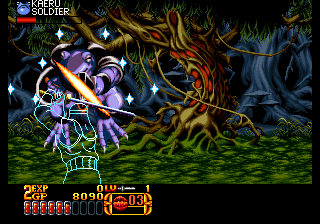
For those not familiar with its predecessor, the sequel is very similar in many ways. Instead of your typical belt-scroller, these games are played from an over-the-shoulder perspective with your character being represented by a wireframe. They operate on a two-plane system, with only enemies in the front being able to be hit by your weapon (enemies in the back can be hit by other means, but it's far and few between). There are desperation moves, which are very powerful or have special effects but cost you health to use. You also hold a limited number of magic spells, which are typically very powerful.


CLINK!

The combat is like no other, playing more like a fighting game than what you'd expect from a beat 'em up. By holding up or down, the player will block high or low. Correspondingly, each physical attack in the game is either a high or a low. By blocking correctly, the enemy will be stunned for a bit which makes them vulnerable to an attack. Of course, all this logic applies to you as well: enemies can block your attacks and counter! As well, you can't block non-physical attacks, like wizards zapping you with their kama. Each enemy has a clearly visible tell for what they're going to do, so it's a very tight test of reaction for most of them, but it's incredibly satisfying and rewarding to pull off a successful guard with a huge CLINK!


A shining example of the wonderful boss designs and beautiful spritework (this is a redesign of the first boss from the first game too!)

The story is exactly what you'd expect: In the great land of Belkana, the Demon Warlord Nausizz arose and sent his hordes of creatures to destroy the land. It's so predictable that what I wrote is actually a plot summary for both games! But of course, we're not here to play beat 'em ups for the story, now, are we? Don't worry about the game being all in Japanese; despite being a Japan-exclusive release, all the text is in English if played on an English Neo Geo CD, so this title is wonderfully import-friendly (as long as you shell out the cash for a Neo Geo CD in the first place)!


Our 3 unnamed heroes, complete with the obligatory ninja

Like the predecessor, this one introduces RPG mechanics: experience points can increase your level which slightly increases your damage output and max health, and you can spend gold collected at the end of an act to buy weapon upgrades, magic and health refills, level-ups, and new magic attacks. This one also expands upon its predecessor by adding a new 'movement' button: pressing left/right+B will allow for a short range dash, and pressing B in place will allow you to jump. The movement is incredibly fluid and makes the game control amazingly, allowing a new dimension to the already great combat. There's also 3 playable characters unlike the predecessor's 1, all with their own inherent strengths and weaknesses: the knight is slow but has excellent attack and defense, the ninja is well-balanced but lacks magic, the mage is speedy and has great magic ability but lacks damage. They're all welcome changes: the first game is fun, but simplistic.


The wonderful shopkeeper. Where does she get all this stuff from?

There's some slight balance issues. I originally played through the game with the ninja because he looked the coolest, but when learning to speedrun this game I noticed the only previous runner used the mage. It turns out the mage's starting spell (the wave, as I call it) is completely broken and practically obliterates every boss up until about stage 5 or 6. I'm not talking about it just making the fights a bit easier, I mean it will literally stun-lock them to death if it even touches them. Later bosses will break the spell after getting hit once or twice. After that, there's one purchase-able spell that puts that one to shame, a full screen meteor shower that hits both rows, can strike enemies multiple times for huge damage, and cannot be broken. Pail Heads in particular have a long stun animation, which means you can stun-lock them with repeated jump attacks. Other than that it's actually fairly well-balanced and you'll feel yourself actually getting better at the game and the playstyle of the character you chose.


In the wise words of Chuggaaconroy, "Ah! Ah! Ah! Ah! Ah! Ah! Ah! Ah!"

The first game was praised for its audiovisual presentation, and its sequel is no slouch either. The sprites are HUGE, very expressive and well-animated. The enemy designs are a perfect mix of your typical fantasy designs (and obligatory ninjas) with some oddballs here and there. There are of course a few recolors, but the sprites are so well-done I honestly don't care. The sound effects are great (the massive CLINK! upon a successful block never gets old...), although the few music tracks there are are just kind of... there. They're okay, but nothing special. The main jingle is pretty nice, but it gets grating to hear on every loading screen in the game.

My personal favorite boss, the Master Samurai, who has one of the coolest boss intros of all-time

The game emulates flawlessly in MAME. If you're averse to trying to get Neo Geo CD emulation to work (my tip: load empty, then insert the CD from file manager), there is a cartridge hack to essentially turn this into a normal MVS/AES game released by Neobitz in 2015 (note to any arcade operators reading this, if you put this game in I will come to your arcade). I highly recommend it even just for a neat one-off. It's an amazingly fun game, and I can only assume even more fun in co-op! (update: I can confirm it is even more fun in co-op) If you'd like to see a speedrun, I ran this in the wonderful event Power Up With Pride 2021 (it was a PB too!).

Friday, April 2, 2021

A Little About Kusogrande

Because Brossentia said I could.

Kusogrande is an annual mystery kusoge tournament run by Brossentia and his ragtag bunch of misfits, and it's the wildest ride you've ever been on. Like all good wild rides, you must adhere to all safety warnings, you may end up mildly out of breath, and must be at least 51" tall to ride.


The inaugural game of Kuso6. Believe it or not, this won a GOTY award in a Korean magazine.

If you don't know what the term kusoge/kuso-game means, I could just give a simple definition, but instead let me give you a good explanation of what it means! Here is a short history of some games I have played in this tournament:

  • Bravoman [TG16] (port of an obscenely-hard arcade platformer)
  • Slam City with Scottie Pippen [CD32X] (an FMV basketball game with the most hilarious writing I have ever seen)
    • ("THE MEEK MAY INHERIT THE EARTH BUT THEY WON'T GET THE BALL!')
  • 4 PAK All-Action [SMS] (a Korean-developed Australian-exclusive Master System 4-in-1 pirate cart, featuring a whopping 1 original game)
  • Sonic Jam 6 [GEN] (a bootleg port of Super Mario Bros. with the worst controls you've ever seen)
  • Camp California [TG16] (a licensed Beach Boys platformer)
(The actual meaning is that クソゲー (kusoge) in Japanese literally translates to 'shit game', but it's a little more complex than that)


Look Ma, I'm on TV!

The tournament is split into the initial group stage, and then a bracket stage. The top 32 players point-wise in the group stage are seeded and placed into a head-to-head bracket.

During the group stage, you get put into a match with 3 other people along with your irredeemably evil lovely Game Master (GM), who will seal your fate by providing you with a game. After a quick check to make sure players have no experience with the game, you're given a bit of direction of how the game controls (usually a scan from the manual if available).

One hour. Go.


You will never see a Watara Supervision game in any other event.

Players are placed according to how much progress is made in this 1 hour timespan. All the matches are streamed through Brossentia's Twitch channel, so it's also a great spectator event!

Unsurprisingly, there's a lot of comparisons between Kusogrande and SRL's Mystery Tournament due to the mystery nature and the speedrunning aspect to it (and being run by a ragtag bunch of misfits). There's a few key differences that make Kusogrande so unique and special though.


This is actually a relatively normal sight on Brossentia's stream. I would say a key difference between Kusogrande and MT is that you wouldn't see anything like this on an MT restream but we have equally stupid stuff.

First, the 1 hour time limit is your saving grace. Let's face it, sometimes you just draw an awful game in MT (SNES platformers!!!), and you are stuck with playing it until you finish the goal, which although is designed to take a short amount of time, doesn't always end up the case. In Kuso, it's a hard 1 hour no matter the quality or length of the game. Trying to put up with an awful game in Kuso is much more doable than in MT.

Second, because of the time limit, there are no hard goals in Kusogrande. You're always working towards something in this 1 hour except in the most extreme examples of some matches. It gives you some determination to keep going: if you're going up against a top-tier MT competitor and hit a big wall, it's a big hit to your psyche! You'll never experience the crushing defeat of seeing Maurice someone .done about 20 minutes before you would.

Third, because of the game choice, mistakes mean you're down but never out. Hard game overs are common, with a lot of jank involved. You never know when your next run could be a miracle and you could sweep the win!

Fourth, the group aspect makes it way more light-hearted; you get an entire hour of setup block to laugh and joke around with your fellow competitors.

And last but not least, the games are all bad*!

*the games are not always bad per se (and there's always varying degrees of badness), but sometimes things are done to make them bad: I played High Seas Havoc [GEN] which is a pretty good platformer, except we were forced onto the hardest difficulty which meant everything was a 1-hit-kill. Kuso has a pretty flexible definition like that.

Not just Athena, Commodore Athena. Please look up the title screen for this version.

You would think a setting like this would leave a lot left up to luck, and amazingly you would be completely wrong. People consistently place high and win events like this, notably event winners AND4H (his middle name is 'winning mystery events'), NPC, and SomeGirl (she is also way too good at everything). There's a massive overlap of people who do well at MT and people who do well at Kuso.


The very first Kusogrande match was broadcast 6 years ago on Sunday August 29th, 2015, featuring Back to the Future [NES] played by SuperNerdMiles and kakusho, and it's still running strong to this day, currently running Kusogrande 6! I've been a regular attender since Kuso 3, and although I have horribly crash and burned every single time (my first match involved me softlocking the game 7 times on the second level) and have yet to even make it out of groups, it's been a blast! Occasionally, you even find games you like (I ended up speedrunning 4 PAK All-Action and had a lot of fun)! The chat is very fun and nice too; it feels less like a competitive event and more like a co-operative experience really!


This game is actually great. 'Great but jank' is standard kuso fare.

It's an event that everyone should watch a match in motion at least once. It's incredibly entertaining, no doubt due to the amazing efforts of everyone involved: Brossentia, the GMs, and the competitors, chat, and everyone else involved with the organization of the event. You will not regret it.

Most importantly, I implore you all to look at the hot new Kusogrande website, kusogran.de. It's glorious. The official Kusogrande Twitter account can be found here, which will tweet about upcoming matches. You can also check out Brossentia and corndan's gaming variety show 'Don't Make Us Bored!' Tuesday nights on Brossentia's channel.

Sunday, March 7, 2021

犬のおさんぽ (Inu no Osanpo) [Arcade (NAOMI)]

You might've though Games2Jolly would take the cake for weirdest games that have been featured here, but they get blown out of the water by this one:

Arcade flyer: Text translates to "One! Two! One! Two! A happy walk with your cute dog!"

犬のおさんぽ (Inu no Osanpo, lit. 'walk the dog'), by WOW Entertainment (and supposedly CAVE, it's on their website) for the Sega NAOMI arcade platform in October 2001, is an arcade dog-walking simulator. Yes, really.

I played a lot of Nintendogs back when it first released and when I saw this game in the NAOMI games list and looked up a video I knew I had to play it. This was another high-effort-to-get-running game because the emulated controls are not exactly obvious (honestly I'm amazed Demul even supports them at all), and when I messaged the only person with a YouTube video as to how they got it working they couldn't remember anything special. Turns out there actually was nothing special, which will probably be a bit surprising in a few paragraphs!


I can never see Shibas the same after watching Oda Cinnamon Nobunaga

You choose one of 6 dog breeds (Shiba, pug, Siberian husky, Pembroke Welsh corgi, poodle, Labrador retriever; they all have cute names too) and one of three routes and go on a lovely little walk with your dog. You can go to the pet store to get more food, walk to a field so you can play with a frisbee, or make your way home from the dog park.

But of course, this is an arcade game! It can't be as simple and mundane as that! First, just look at the "controller" for this game: 


If I ever get to open my 'I won the lottery and have way too much money' arcade, you can bet I'll have this cabinet in there.

Yes, it's a treadmill. A treadmill, a fake plastic dog, and a lead. It might be the most bizarre control scheme I have ever seen for a game. When playing on emulator the control scheme might actually be even more of a mess, because the treadmill is bound to mouse movement. (and moving it even an inch before starting the game will simulate treadmill movement and will cause a BELT ERROR, complete with an annoying alarm and warning screen that only goes away by going to test mode and clearing it)

We failed to dodge the skaters; you can see one of them wiped out in the back

The game's not very pretty; it looks like a very early Dreamcast game which is disappointing for arcade stuff at the time (though everything looks disappointing compared to Planet Harriers, which was one year earlier). The music is okay and cute. There's nothing special about either: this isn't exactly the kind of game you'd play for the cutting-edge graphics, now is it?


Don't let your dog eat garbage in the road!

As expected with an arcade game, you are graded and scored based on your dog's mood meter. Successfully walking it, letting it investigate where other dogs have done their business, and completing in-level missions will raise it and cause your dog to prance around hilariously. Outrunning or moving too slow for your dog, letting it eat trash, or failing missions will lower it. Lowering it all the way will give you a GAME OVER, and your dog will be very sad.


Dodge the car!

The missions are really the highlight of the game: middle-aged women trying to catch a cat who stole their fish, getting attacked by crows, avoiding cars or bikes in the middle of the road, or even a series of 'fights' against a particularly mean bulldog, and that's not even listing the most ridiculous one of all. They're pretty outlandish and feature some funny animations, win or lose. They're also not too hard once you figure them out (except frisbee, I still can't manage to do that one at all).

Complete with bad Japanese puns!

It's honestly pretty fun, and worth it just to see how weird it is. Given that it's an arcade game, it's very short, probably 15 minutes for the longest route at the most. It's something that I can recommend at least playing through each of the routes once, you will probably laugh your ass off at least once in each. And of course, if by some fortuitous chance you actually see this in an arcade somewhere, you better play it.

Saturday, February 6, 2021

Games2Jolly.com [Browser]


The screen you'll be greeted with every time you start a game, complete with a terrifying animation.

Games2Jolly.com is a presumably Indian (based on some oddly-named terms in the games) developer of Flash/HTML5 escape room games, who have made one every single day since 2013 or so. There's seriously almost 2000 of them! Complete with amazing titles like 'Car Escape from Dilapidated Area', 'Hifi Mall Lift Rescue', 'Grandpas Love for Music', or 'Old Scooter Escape'! 


A typical Jolly screen.

Members of the Mystery community found these games and after enjoying racing a few of them, decided to hold a tournament of racing through these games. At first, I didn't know what to expect. I joined the inaugural race to see what it was like and got absolutely demolished and hated every second of it. I join every event possible in the community so I joined anyway. After racing a few (I ended up making to top 5 and lost as my mouse stopped working, go figure), I knew it was something special and had a blast, and it ended up being a very memorable and fun tournament for everyone involved.


This is the current image for the SpeedrunsLive page for this game, by the way.

Basically, most games are differently skinned versions that use a lot of the same puzzles: put objects at specific heights, match colors to some clue, enter a word you saw on a sheet of paper, etc. You can interact with things in your inventory if they open a separate screen, which is sometimes necessary to use items on. You usually have to collect some items to put in holes to open something that either gives you clues or an end-game item. Sometimes there are dumb pixel hunts that everyone hates. Every puzzle is also set up so that you cannot input the solution until you've actually seen it in-game, so (almost) no brute-forcing can be done. There's also two different 'generations' of Jolly games that use two different engines (you can discern these at a glance as the newer games are in 16x9 while the older ones are in 4x3) that play a bit differently. The newer engine games are far better than the old ones. If you get stuck, there are video walkthroughs hosted on the Games2Jolly YouTube channel that you can access by pressing the >Walkthrough button in-game (some of these are quite funny due to the hilariously deliberate mouse movements). The game tracks your in-game time and gives you a score that is mostly based off of time. It wasn't consistent in all of our testing but it was roughly 5,000,000/seconds in most cases.


This cool guy was my personal vote for the SRL page image.

They usually have some hilarious lore on the splash screen before starting the game, not just because of the Engrish involved but the ridiculous scenarios they had to come up with to fit a game in there. Many are sadly boring text that just say "We know that you are a great fan of Escape games but that doesn't mean you should not like puzzles. So here we present you with [game name]. A cocktail with an essence of both Puzzles and Escape tricks." (deemed 'cocktail' games by our community)


There's too many examples of great lore, it was so hard to just include one!

The games are pretty much what you would expect from bad flash escape room games: esoteric puzzles, almost entirely ripped assets, royalty-free music (through a bit of detective work courtesy of Exuno and SomeGirl, we found the source for a bunch of them here and it turns out that even though the music is free, they still used a watermarked preview version!), and hilariously crude animations. There's a few recurring characters amazingly, most notably the mascot Jolly Boy and Jolly Girl.


Wouldn't be complete without some hilarious love story...

On their own, they're not fun at all frankly. It's frustrating, stupid, complete nonsense puzzles. There's little consistency in how you actually progress, in how long the games are, or how funny the scenarios are.


This image, plus the flaming lion head and cool guy are all actually from the same game, 'Princess Magic Rescue I', which was easily the best match of the tourney.

But this is a rare case of a game where the true way to play is get in a voice chat with some friends and race through them. I'm serious. It really shouldn't be fun but it transforms it into such a fun and hilarious experience that I can highly recommend doing it just for that. It's honestly some of the most enjoyable races I've ever done, and although I think it was a bit scary how I ended up kind of learning the 'jolly logic' for the puzzles, it was entirely worth playing them. Make sure to liberally use some screenshotting tool (I used PrintScreen + paste into MS Paint); it will save you a huge amount of headache. Side note: don't play the HTML5 games though, they're just not as much fun.


The most important part of the game: Jolly Escape!

You can play these games either on their website which I don't recommend, or through the Flashpoint archiving project. Good luck and have a fun! Jollymania...

Wednesday, December 9, 2020

硯 (Suzuri) [PC]

I got interested in this game after browsing Romhacking.net's translation section for PC games (I was probably browsing for Mystery Tournament submissions or something?) and saw this title, which immediately grabbed my eye because its genre was listed as "Other". I'd like to think I'm pretty good at distilling games into succinct yet detailed genre names, but I must admit there are even a few I would have to qualify as "Other" which automatically makes them interesting to me. The description by Non-Directional Translations describes it as a "paintbrush game" which is probably my new favorite name of a video game genre.

硯 (Suzuri, lit. 'inkstone') is an odd-little PC game released by ABA Games, a doujin circle who have made some excellent doujin shmups like Noiz2sa and rRootage, released for Windows 95 in 1998. The game is best-described as an 'avoid-em-up', basically like a shmup except that you can't shoot and there are no enemies, which makes the game sound a lot less fun than it actually is.


You play as a bright red-orange stroke of paint in their quest to avoid suddenly appearing kanji characters. There are two game modes: 素人 (novice, which I think is actually mispelled in game; it's missing one of the horizontal bars) and 玄人 (expert), which doesn't change the actual 10-level 'course' but makes your stoke move way faster. Your stroke's hitbox is not very obvious but it seems to be concentrated around the center of the stroke. Of course, this is pretty hard to tell when moving up and down but that's a lot of the challenge of the game. The stroke has a nice sense of momentum to it, which is definitely odd for a paintbrush but actually works to this game's benefit and it makes the dodges and maneuvering even more impressive and fun.

The game is surprisingly fun and addicting, one of those styles of games you'd expect to see on a cheap ad-filled mobile game nowadays but actually pretty good. It has that same feeling as making a very tight dodge in a shmup (and this game has a lot of tight dodges), and the whole game is short, sweet, and challenging enough to be interesting and very replayable. This wasn't this developer's first game as far as I can tell (they do have a few PC-98 games but none of their games are dated on the website) but I'm impressed they got that feeling right away. Maybe this game just appeals to my shmup-nut nature, but I think it's got some legitimate talent in it.

Of course, the real draw of the game is the visual style. The brush strokes are all well-animated (and most all of them are made in the correct order, which is a nice touch) and look very real. Even your stroke's motion at different speeds matches what would happen with a real brush. The entirety of the level is all classic-looking black strokes (aside from bright orange progress/time markers) which makes the visual effects very striking and oddly mesmerizing when moving at fast speeds. Whether flying through huge 山s or a sea of 人s or huge corridors, the game's look never gets old. Even seeing it in stills like this really doesn't do it justice. It's one of those visual styles you hope somebody on itch.io picks up and makes a neat game out of. 


Trying to get this game to run was kind of a nightmare, albeit mostly of my own accord due to my ignorance of Windows 95/98 and emulation. PCem is an excellent way to emulate old IBM PCs and Windows machines, and thankfully there are excellent tutorials (I personally used this one) to install and get games to run. Trying to install the game was another story, as it took about 3 days and many hours between them trying to troubleshoot a nasty InstallShield error where every single post about it on the internet is about the same error caused by far more serious causes. After many reinstallations of Japanese Windows 98, many different methods of making a disc file for PCem, I found out that the reason I was getting this error was that the directory the installer was located in (my virtual floppy drive in PCem) was read-only. After moving all the disc's files to my desktop and installing without a hitch I was almost too mad to even play the game! I was happy I persevered though; it was a fun little experience for the short few minutes it takes.

(note: this isn't actually my high score, just the only run I decided to take screenshots of because PCem's wonderful unrebindable screenshot key of Ctrl+Alt+PageUp doesn't make it easy even in a game like this that only required one hand)

Maybe it was just relief after the hell it was to get this to run, but I can recommend Suzuri if you're into short, weird, arcade-y Japanese titles and don't mind complicated emulator setup, especially if you're a huge shmup fan like me.

If you would like to play this game, it is freeware and available on ABA Games' website. An English translation is available on Romhacking.net courtesy of Non-Directional Translations here.